

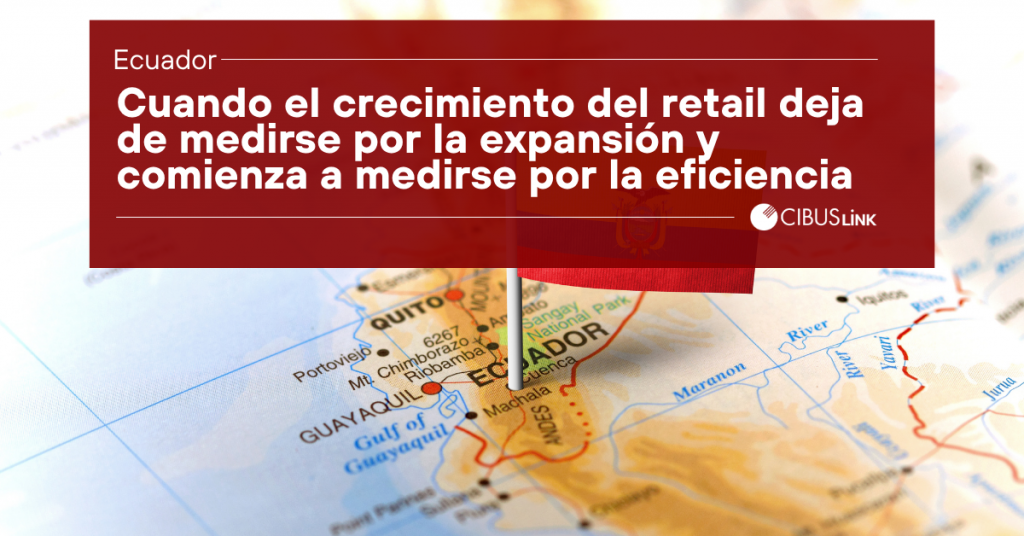
For many years, the analysis of Latin American retail has centered on a single variable: the opening of new stores. This metric is not enough for you to understand where the market is headed. Ecuador probably represents one of the best examples of this new era.
The data from 2025 show that the modern channel continues to gain participation, increasing approximately 48% of mass consumption, while traditional trade continues to lose relative weight. However, the truly relevant aspect is not growth, but the form in which it is taking place. Competitive leadership does not depend exclusively on the quality of the commercial red. It depends on the productivity of each point of sale, the speed of rotation, the logistical efficiency and the ability to offer value to the consumer without deteriorating profitability.
It is precisely this perspective from which the evolution of operators as Corporación Favorita, Corporación El Rosado, You, Aunt o Coral. Each responds to a different strategy, but all converge in the same direction: building commercial models capable of operating with much more efficient cost structures than in just five years. The presence does not come solely from the competence between cadenas, it also comes from a consumer who has changed profoundly.
The Kantar studies corresponding to 2025 show a particularly significant phenomenon: the market continues to grow in value while the volumes decrease. In other words, Ecuadorian families buy fewer units, compare more alternatives, visit a larger number of channels and carefully analyze each purchasing decision, and this behavior completely changes the logic of the shop.
Over many years the growth could be achieved by increasing the growth, expanding the sales surfaces or incorporating new categories, therefore the aim consists in increasing the productivity of the inverted capital, each SKU must justify its permanence, each square meter must produce more, and this evolution also explains the fortress of the private brand.
The growth should not be interpreted solely as a response to the price, it represents, above all, a strategy to increase the control of the management chain, improve the managers and differentiate the commercial proposal.
For the Italian food industry, this scenario obliges us to review some traditional paradigms. The prestige of Made in Italy He continues to be an asset of enormous value, but he does not constitute, by himself, a sufficient competitive edge.
Ecuadorian retail is looking for manufacturers capable of offering continuity of supply, industrial flexibility, efficient logistical structures and sustainable prices. Quality continues to be indispensable, but has become the only decision factor.
Consequently, categories such as pasta, sauces, tomato derivatives, coffee, sweet creams and other emblematic products of Italian gastronomy maintain a high potential for development. However, the opportunity does not reside solely in selling Italian products, but is integrated into the growth strategies of retailers through private brand projects, exclusive designs and proposals adapted to each commercial format.
Here's the main point that comes from Ecuador: the market is demonstrating that the next phase of Latin American retail will not be defined by this in more areas, so it is advisable to operate with greater efficiency. In this new context, the truly competitive differentiation will become the size of companies to convert to the quality of their operational model and this is a signal that widely transcends the borders of Ecuador.