

Eroski is investing €30 million in promotions, discounts, and special offers to help Spanish families cope with back-to-school expenses, one of the most challenging times of the year for household budgets after the summer break. The promotional investment planned for September is equivalent to 21% of the group's expected sales for the period and adds to the nearly €208 million in savings passed on to customers through offers and other benefits between February and July 2026. According to consumer data analyzed by the retailer, during the first week of September, loyal customers' spending increased by 6,9% compared to the weekly average in 2025, reaching €124 per family.
During the same period, unit purchases increased by 10,2% and the frequency of store visits by 2,4%, a sign of greater price awareness and more careful planning. Families tend to spread their shopping across multiple occasions, allowing them to better manage their budget and take advantage of available promotions, while three out of four shopping carts are used for weekly or biweekly pantry replenishments. The average value of baskets containing back-to-school products reached €34,5, compared to €33 for the usual shopping experience, a 4,5% increase; of this, €16,8 is allocated to seasonally specific categories.
Consumption is driven most by young families, whose share of sales increases by 1 percentage point, followed by households with older children, which grow by 0,4 percentage points, while the share of retired families decreases. The peak in purchases is concentrated in the first week of the month, and compared to the rest of the year, Monday becomes the preferred day for shopping, with no significant differences across channels. Hypermarkets recorded the most significant increase in market share, equal to 4,1 percentage points, thanks to larger purchases and the greater availability of school supplies, clothing, and technology products.
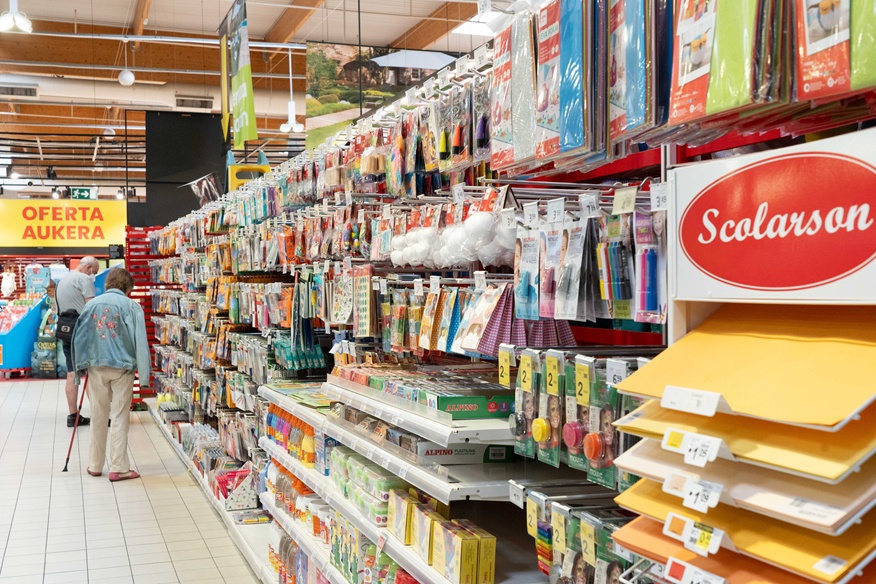
Local supermarkets and convenience stores also rose by 1,8 percentage points, boosted by proximity and the ability to make frequent purchases, while online sales grew by 1,4 percentage points, especially among young families. School supplies led the increase in sales, up 115,5%, followed by children's clothing, up 22,2%, and home decor items, up 9,2%.
Overall, back-to-school categories, including personal care, snacks, and breakfast products, account for 38,5% of sales. Food products continue to play a key role in shopping carts, with snacks accounting for 20,8% and breakfast items for 10,3%. School supplies, children's clothing, and technology also contribute to traffic in stores and online, driving purchases of milk and dairy products, baked goods, and fruit. On the promotional front, Eroski offers deals such as 2 for 1 and 3 for 2, second items discounted by 50% or 70%, personalized coupons, and contests, along with benefits reserved for Eroski Club members and Tarjeta Oro card holders. In technology, promotional sales reach 75% of the category total, while they exceed 45% in school supplies and 37% in detergents.
Furthermore, 26,9% of consumers fall into the "coupon-crazy" category, defined by the company as "coupon-crazy," particularly sensitive to savings opportunities, which grew by 8,9 percentage points compared to the annual average for 2025. The use of interest-free financing through the Tarjeta Eroski, used by families to spread the financial burden of the so-called "September surge," also increased by 10%. The sales campaign will be accompanied by the "En septiembre hay un ti" initiative, with which the cooperative intends to combine financial support with a message dedicated to personal care during the return to routine. "The return to school season condenses many important purchasing decisions for families and the home into just a few weeks," emphasizes Beatriz Santos, Commercial Director of Eroski. "Our goal is to support them with a value proposition that combines savings, quality, and a broad selection, tailored to their needs, helping them build a balanced and accessible shopping cart." For Santos, however, being close to people also means supporting them in resuming routines and responsibilities, reminding them that, amid the many daily obligations, it is important to keep some space for themselves.