


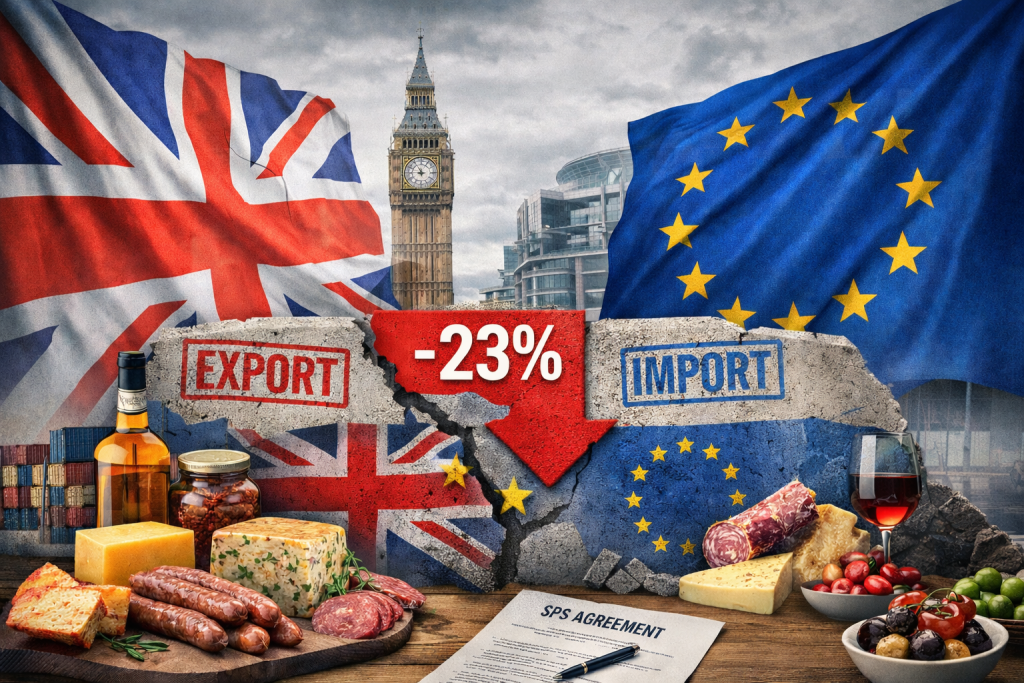
British food and drink exports to the European Union have fallen by more than 20% compared to pre-Brexit levels. This is according to the latest Trade Snapshot from the Food and Drink Federation (FDF), which estimates an overall decline of 23,4% over the last five years compared to the period 2016-2020. The report highlights a particularly sharp decline to some of the EU's key markets. Between 2021 and 2025, exports to Germany fell by 59,1%, those to Poland by 51,9%, and those to Belgium by 39,9%.
According to the FDF, the figure reflects the structural impact of new trade barriers introduced after the UK's exit from the EU, in an environment already complicated by rising production costs, regulatory pressure, and weak domestic demand. Karen Betts, CEO of the Food and Drink Federation, emphasized that removing trade barriers with the EU is now crucial for the sector. The European Union remains the UK's main trading partner.
Meanwhile, exports to non-EU markets are showing a more favorable trend. In the first nine months of 2025, global food and drink exports grew by 5,8%, driven primarily by non-EU countries, which recorded a 6,2% increase in value year-over-year. Data to India (+9,6%) and the Gulf Cooperation Council (GCC) countries (+6,3%) were particularly positive. Imports from non-EU countries are also on the rise, up 17,1%, bringing the total value of British food imports to £49,6 billion.
In this context, the FDF welcomes the negotiations between the United Kingdom and the European Union for a new Sanitary and Phytosanitary (SPS) Agreement. The aim is to reduce controls, costs, and complexity in post-Brexit agri-food trade. In November, the European Council authorized the launch of negotiations to create a common SPS area and link the EU ETS. At the May summit, the two sides had already agreed to work on simplifying cross-border trade.
The British government has indicated that the agreement could lead to the removal of some controls on animal and plant products, promoting the free movement of goods and helping to reduce shelf prices. The FDF warns, however, that the SPS agreement will not be a permanent solution. Clear transition periods, support for businesses, and complementary policies on packaging, labeling, and customs procedures will be needed.
The association also calls for a ten-year plan to grow UK food exports to £35 billion by 2035, without compromising the resilience of supply chains. Among the proposals is a £2,6 million fund to support the internationalization of businesses, particularly SMEs, by replicating models already in place in Scotland and Wales and strengthening their presence at trade fairs and international promotion initiatives.