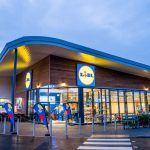


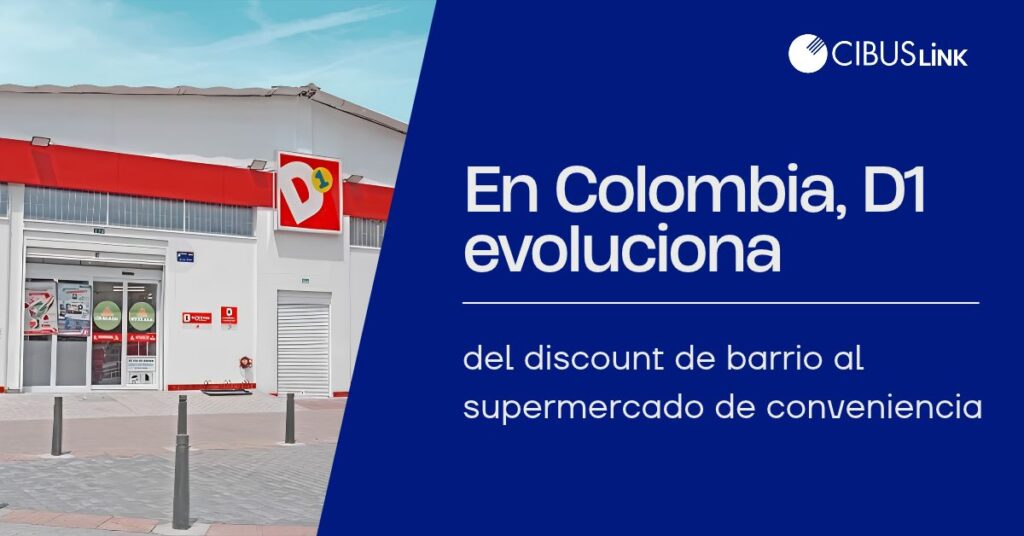
The leader of the Colombian market, D1, is located in small areas of approximately 200-250 square meters, which favor its extraordinary capilar penetration in urban and popular neighborhoods, to experiment with a larger surface area, more references and a greater depth of surface. The underlying identity does not change - convenience, accessible prices, pragmatic appeal and a strong popular vocation - but the way in which this promise is presented to the consumer does change.
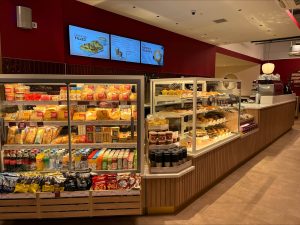
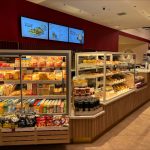
The new format appears to be more structured: the central freezers, the vertical refrigerated containers with doors, the main space dedicated to the frozen items, the presence of fruits and vegetables at the entrance and a greater depth of surface make for a more complete shopping experience. The result is a discount that is sought at the supermarket, without abandoning the beginning of the low price.
Of the price for the purchase mission
The historical objective of D1 was to democratize the access to the products of the daily purchase: to offer quality, good quality and convenient prices in a country characterized by great differences in income, by the overall relevant weight of the traditional channel and by a high sensitivity of the consumer to the price.
This strategy was successful because D1 was able to fit in, at the same time, both in neighborhoods with greater gas capacity and in popular areas, positioning itself as a simple, simple and reliable place. On a continent marked by profound social differences — and, above all, by the distances between one area and another —, D1 is now one of the very few operators who have achieved this result. To see it better, Tiendas 3B still didn't achieve it in Mexico; All in Ecuador; and Tiendas Mass is attempting it with great determination in Peru. But it is not an automatic result and is not easy to achieve.
D1 has built its development by capturing winds mainly from the traditional trade — small retailers, neighborhood shops and independent trade —, although it has also progressively remained traffic and shopping frequency at supermarkets and other modern operators.
However, the new format raises the price: you don't only focus on the purchase of the deposit or the top-up shopping, it is clear, to the rapid rebasting of a few essential products. Thanks to the strength of the refrigerated and frozen categories, of fresh products and of fruits and vegetables, the company can aspire to capture a growing proportion of weekly purchases or even of the main store purchase.
It is an important step: D1 it is not only the point of sale where you can buy some indispensable products at a low price, but it can convert into a credible alternative for a wider shopping list.
La señal de los frescos
The decision to unpack frozen items, meats, chicken, stuffed vegetables, refrigerated products and fruits and vegetables in a visible manner is probably the most relevant element of the new format.
In the locations of this new model, the ice cream should be a marginal presence and become a structural component of the offer. The glass doors closed with glass doors also reflect the perception of order, hygiene, conservation and modernity, while horizontal freezers prolong the customer's stay in the sector and favor impulse purchases as much as motivated by convenience.
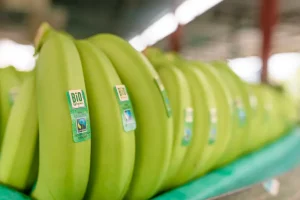
The location of fruits and vegetables in the entrance also has a symbolic and commercial value: it incorporates a daily shopping category, increases visit frequency and contributes to clearing the location of the shop for a more complete shopping mission. In other words, D1 covers not only the pantry, but also a growing part of the consumer's pocket.
A more European model, adapted to Colombia
The comparison with European models is evident, although it should not be interpreted as a simple import of formats. D1 seems better to adapt some principles of the evolved design to the Colombian conditions: a larger surface area, a better legibility of the layout and a more profound surprise proposal, but still selected.
The shop maintains the centrality of convenience, becoming a traditional supermarket, although it has distinct categories of fresh products and controlled temperatures. Also evident are the inversions in furniture and equipment that increase the quality.
The wind point preserves some of the reasons behind the story: exposure in cardboard boxes, rationality in the use of space, strong focus in rotation and limited inversion in theatricality. However, the leap in quality of the surroundings and the offer is similar to the experience of a convenient supermarket.
El reto: crecer sin canibalizare
The evolution opens up opportunities, but also implies some complex strategic strategies. The first one refers to the possible canibalization of the existing red. D1 has built its leader through a very dense presence and a logic of proximity: if the new big leagues are short of looking for the traditional wind points, a part of the winds runs the risk of moving internally where they will be captured by the competitors.
The second task is logistics. Expanding the weight of fresh, refrigerated and frozen products implies significantly raising the completeness of the supply chain: constant availability, inventory management, stock reduction, quality of the cold supply chain, frequency of deliveries and ability to maintain competitive prices. This is where the model must demonstrate that it can scale with the same efficiency that has already been demonstrated in the dry and large conservation categories.
Lastly, D1 must avoid that the increase in the number of references compromises one of its main competitive factors: operational simplicity. A more profound surprise can increase the value of the basket and the customer's loyalty, but also raises greater risks of completion, less rotation and attention over the costs.
The truth will be, therefore, to find the point of balance between three needs: to expand the gas captured, maintain the efficiency of the delivery and preserve the capilaridad that has converted to D1 in a representative of the Colombian retail.
A laboratory for the next few years
The new format should be read as a concept drawing. If the experiment generates increases in turnover and market price without penalizing excess in the traditional businesses sought, D1 could accelerate its diffusion in the main cities and in the densest urban areas.
It is realistic to imagine that, in the middle of the day, these points of sale can lead to a significant participation within the red - quizzes of the order of 10% to 20% -, especially in the areas where the consumer base supports a more complete purchase and where the competitive presence of supermarkets, shops and traditional channels is greatest intense.
In short, it is not just a new company: it is the signal of a transformation of the D1 paper on the Colombian mass market. The company continues to be based on convenience, but aims to become a broader, more modern and more competitive shopping destination. The next step will be to verify that this consigue evolution will capture additional winds of competitors - in particular, supermarkets and traditional retailers - without weakening the extraordinary density and productivity of the red one built up to now.