



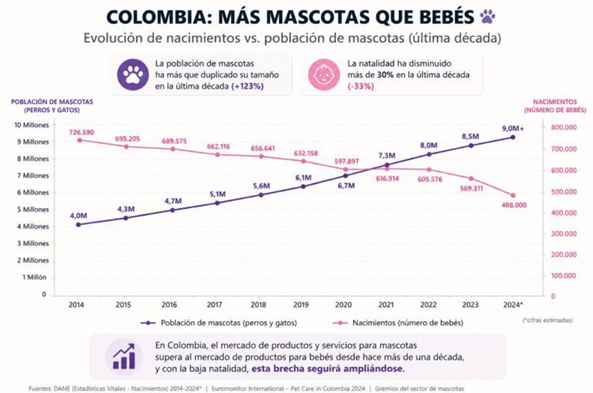
The graph circulating in Colombia comparing the growth of domestic animals with the decline in birth rates isn't a social media curiosity. It's a visible symptom of an economic, social, and cultural shift that is a consolidated reality in many "first world" countries but is beginning to affect a large portion of Latin America.
I'm in Bogotá for work these days, and while I'm here, I saw a graph about Colombia on LinkedIn that struck me more than many theoretical discussions about the transformation of its society.
The title of this infographic is straightforward: “Colombia: more mascots than babies”The purple curve indicates the population of dogs and cats; the pink curve indicates the annual number of births. In ten years, according to the sources reported in the infographic—DANE for births and Euromonitor for pet care—pet numbers have increased from approximately 4 million to over 9 million, while births have dropped from 726.590 in 2014 to an estimated 488 in 2024 in a population of approximately 50 million. The pet population has therefore more than doubled, while new births have decreased by approximately a third.
The first clarification is methodological: the graph compares a population—the total number of dogs and cats—with an annual flow, that is, births in a given year. Therefore, it doesn't demonstrate, in a strictly statistical sense, that Colombia has "more pets than children." But it captures and immediately highlights a real phenomenon: the explosive growth of the pet world coincides with a drastic and continuous decline in the birth rate. I searched online for the most recent official data, and they confirm the direction of the curve: in 2025, Colombia recorded 433.678 births, 4,5% fewer than in 2024, with a provisional total fertility rate of approximately one child per woman: a level far from what they call the generational replacement threshold, equal to 2,1 children per woman. In my opinion, the most relevant aspect is not only the collapse in the birth rate, but the place where it is happening: Colombia, in fact, is not a rich and mature society like Japan, South Korea, Germany, or even Italy, although the latter cannot be compared to at least two of the three mentioned above.
It is certainly a growing country with a dynamic economy and a rapidly expanding middle class, especially in large cities. However, its per capita GDP remains around $8.500, a level that still places the country far behind the advanced economies.
Hence my reflection: for a long time, the pattern seemed linear: poor countries had high birth rates, and rich, urbanized, and mature countries had fewer children. Today, it seems, that sequence has been broken: the declining birth rate precedes consolidated prosperity, and it arrives while social mobility remains incomplete, while the quality of services is unequal, while many families still live in fragile conditions, and while economic security is far from Western standards.
So I think: we don't just export products, commercial formats, international brands, digital platforms, tourism, entertainment, and consumption patterns; we also export individualism. So-called advanced societies have consolidated a model that presupposes, in order to maintain certain "quality of life" standards, the postponement of stable relationships, children being considered complex and costly projects, the constant pursuit of freedom without permanent constraints, and all of this based on one certainty: the idea that personal fulfillment must precede, and sometimes replace, family continuity.
I'm not trying to caricature this: a dog or cat isn't automatically a "replacement" for a child, and most importantly, not every family that adopts an animal means giving up parenthood. However, it would be naive not to see that the expansion of pet care is also indicative of a broader shift that affects some aspects of parenting.
Far be it from me to elevate this reflection to an anti-capitalist manifesto; that would be blatant hypocrisy. But there's no doubt that this economic system, the best of those existing today (in my opinion), is certainly good for its ability to generate wealth, innovation, mobility, and opportunity. However, the problem arises when wealth becomes the dominant criterion by which all human choices are judged: if children are primarily evaluated as a cost, a constraint, a sacrifice to a career, a brake on consumption, a loss of freedom, or a factor of uncertainty, the decision to have children becomes increasingly fragile. And if every choice is postponed while waiting for perfect conditions (perfect home, perfect job, perfect income, perfect relationship), the postponement can easily turn into renunciation.
In my opinion, the deepest key to this phenomenon also concerns the crisis of Catholic culture. I'm not talking about a religion reduced to a private precept or a nostalgic return to social models of the past, but it is certainly a shield protecting a heritage of values that have shaped society for centuries: the centrality of the family, the value of motherhood and fatherhood, the dignity of unborn life, continuity between generations, responsibility toward children, and the idea that freedom does not consist in the absence of ties, but in the ability to form lasting bonds. In my poor and imperfect vision, Catholicism—with all its historical contradictions and the difficulties it faces today—has always emphasized one essential point: the individual is not an isolated entity, and wealth is not the ultimate goal of existence. Consequently, a child is not a luxury item or a purely private choice, but a good for the family and then for society. This inevitably leads to a trickle-down effect on the economy and the future of a country. And so, if on the one hand communism fought religion head-on, in the name of a totalizing ideology (incompatibility of two dogmas), I sadly think that contemporary capitalism erodes it in a more discreet way.
Let's not forget that this effect has a huge social and economic cost: fewer children means fewer young people, fewer workers, fewer entrepreneurs, fewer consumers, and fewer taxpayers in the future. Meanwhile, the number of elderly people, pensions, healthcare spending, and the need for assistance increase. It's an arithmetic dynamic, and the consequence isn't more generous welfare; in fact, it's often the opposite: taxes and contributions required of those who work increase, but the perceived quality of services deteriorates.
My generation is greatly to blame, and this writer is among the worst offenders. But simply denouncing these dynamics isn't enough; we should take action, with culture and respect for our history, made up of religion, customs, and sacrifices—great sacrifices that are unthinkable today.