

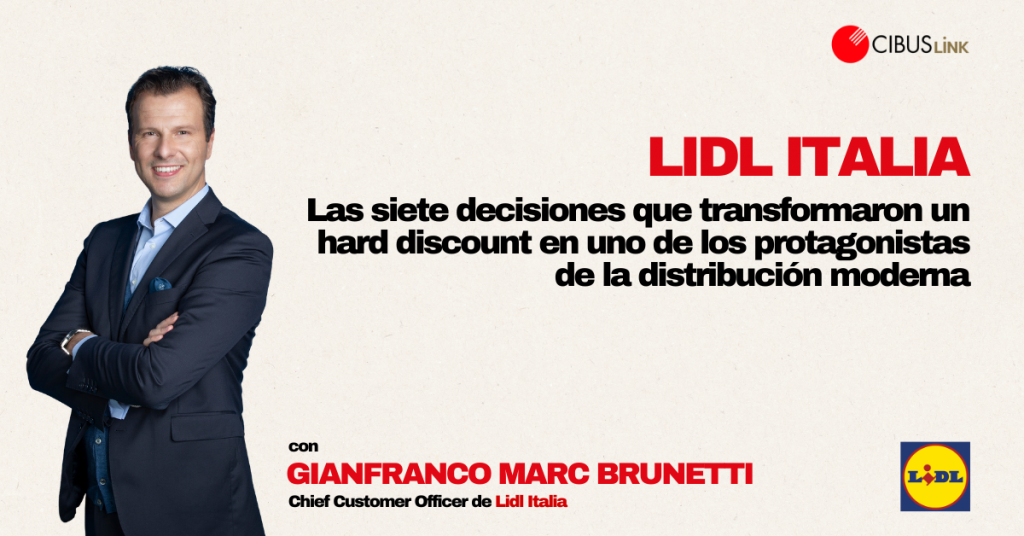
However, Lidl's growth is not solely a competitive pricing policy. During the TuttoFood Italia 2026 fair, Gianfranco Marc Brunetti, Director General Consumer of Lidl Italia, explained how the company was progressively transforming its retail model, moving from being a hard discounter to a modern supermarket. A journey that today constitutes a reference for those countries, especially in Latin America, where the discount channel goes through a phase of development similar to the one experienced in Italy five years ago.
When in 2012 Lidl launched the slogan “Don't change your lifestyle, change the supermarket”, many simply interpreted it as an advertising campaign. However, this message represents an authentic statement of principles.
The objective was not to convince the Italian consumer to buy in a discount store, but to understand that Lidl would be like a supermarket capable of competing with anyone else, maintaining at the same time the main competitive factor: convenience.
During the meeting with the CEO of Food Retail Italia Andrea MeneghiniBrunetti explained that this transformation was the result of a series of strategic decisions which, accumulated over the years, profoundly modified the position of the school.
Las vamos a analizar:
1. Understand that the German model cannot be copied
Lidl arrived in Italy at the beginning of the 20th century with the classic hard discount format: with a thousand references, stores in 800 square metres, merchandise displayed directly on pallets and an organization designed to maximize operational efficiency.
This model worked perfectly in Germany, but the Italian consumer had completely different expectations.
The first big strategic decision consisted, therefore, in understanding that exporting a successful format was not enough: it was necessary to adapt it to the reality of the Italian market.
2. Convert into an Italian company, not just seem like it
During the first few years, the Lidl logo was accompanied by the Italian flag as a symbol of search for the consumer. With the passage of time, this banner would disappear, not because Italianness had lost its importance, until the company had incorporated it in a real way through its purchases, its operations, its success and its presence in the territory. As Brunetti explained, the real objective never seemed to be Italian, until it became a fully integrated company in the Italian market.
3. Multiply the damage without losing efficiency
The evolution can also be estimated in figures, from approximately the initial references, Lidl has moved to offering more than 3.500 products every day, while the average size of its stores has increased to between 1.200 and 1.500 meters squares.
The above continues focusing mainly on its own brand, which represents around 80% of the offer, although without giving up the main brands of the manufacturer, considered fundamental to satisfy the expectations of the Italian consumer.
4. Transform the convenience into good quality
The economic crisis since 2008 made it easier for new consumers to join the discount channel without the embargo, the growth of Lidl cannot be explained solely by the macroeconomic context. The real outcome was to ensure that these customers returned once and again thanks to the quality. The company's most recent slogan perfectly summarizes this philosophy: “Come for convenience, come for quality.”
A promise supported by a strong reversal in the quality of primary materials, the control of the supply chain and the incorporation of premium products that for only a few years you might have imagined finding in a discount store.
5. Convert fresh products into a different item
One of the most interesting aspects of the interview was the strategic paper of the fresh categories. Brunetti explained that each product of fruits and vegetables is subject to four quality checks before reaching the store, so that new checks are carried out daily at the stores. It is not merely an operational process, it is the form in which Lidl has built credibility in front of a particularly demanding consumer in terms of food.
6. Become a strategic partner of the Italian agri-food sector
However, Lidl does not only represent an important distribution network, it is also one of the main channels for promoting Italian products in Europe. Between Lidl and Kaufland, the group markets approximately 10% of all Italian fruit and vegetable exports, a figure that reflects the economic weight that the company has gained throughout the country's agri-food chain.
7. Continue to grow without losing your identity
Concerning the future, the strategy continues to be clearly oriented towards expansion, the stated objective is to achieve more than 1.000 assets in Italy before 2030, opening up five new assets each year and extending this growth with a 1.500 inversion plan million euros.
At the same time, the company will continue to evolve further to respond to new consumer trends, as the development of Vemondo, on its own brand specializing in vegetable products.
In addition to digitalisation and herramientas like Lidl Plus, Brunetti here subrays another essential element of the company's strategy: always targeting the people in the centre, both the customers and the more than 23.000 collaborators who form part of Lidl Italia.
A lesson that also aims at Latin America
Gianfranco Marc Brunetti's intervention transcends the specific case of Lidl. Many Latin American markets are currently experiencing a growth phase of the discount channel very similar to the one experienced in Italy between 2008 and 2020.
Italian experience shows that price constitutes only the door of entry into the relationship with the consumer. Sustainable growth is built by adapting the format to the characteristics of each market, encouraging quality, generating confidence and transforming a discount chain into a supermarket fully recognized by consumers.
This is probably the main point that comes from the conversation in TuttoFood 2026: the success of the discount store does not depend on whether it is simply a discount store, but rather evolves without giving up efficiency and the value proposition that the competitive company has had since the beginning.