
2025 marks the first full year as an independent company for The Magnum Ice Cream Company, formed from the separation from Unilever and listed in Amsterdam, London, and New York last December. A "first" as a standalone company, it, despite demonstrating operational solidity, disappointed the market in terms of profitability and cash generation.
The group closed the fiscal year with revenues of €7,9 billion, stable compared to 2024, but with organic growth of 4,2%, outpacing the global ice cream market. This growth was supported by a 1,5% increase in volumes and a 2,6% price effect, while the negative impact of exchange rates (-4,3%) brought the reported growth to -0,5%.
Profitability, however, weighed heavily. Net profit fell 48,4% to €307 million (€595 million in 2024), reflecting higher separation and restructuring costs, new financial charges, and the impact of transitional service agreements (TSA) with Unilever. Operating profit stood at €599 million (€764 million in 2024).
Adjusted EBITDA decreased to €1,255 billion, with a margin of 15,9% versus 16,9% the previous year. The 100 basis point decline was partly attributable to exchange rate effects and partly to higher cash costs related to TSAs in the second half of the year. The adjusted EBIT margin also decreased to 11,6%.
The drop in free cash flow was particularly significant, falling from 803 million to 38 million euros, due to extraordinary outlays related to the demerger (564 million), interest on the new debt, implementation of the provisional operating model and increased investments in production capacity and the freezer fleet.
The market reacted sharply: the stock lost approximately 13,9% in the morning, temporarily halting trading, marking its sharpest decline since the stock was listed. After a gain of approximately 30% in the weeks following the spin-off, investors revised their expectations in light of lower-than-expected margins and continued weak cash generation.
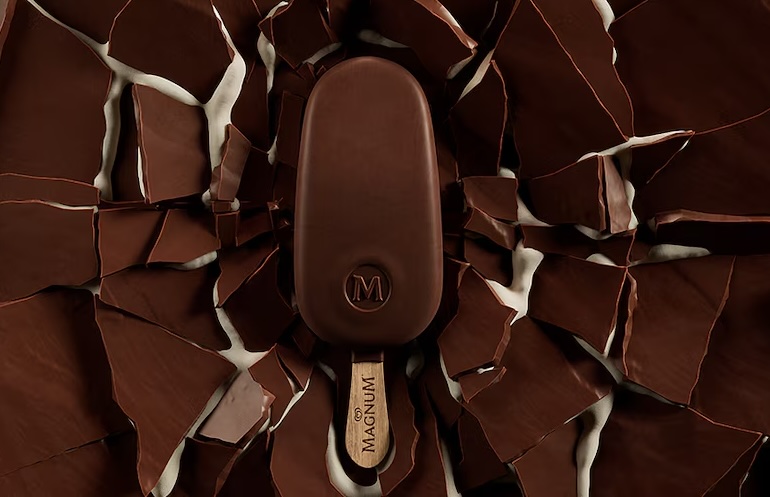
On the commercial front, all regions contributed to organic growth: Europe & ANZ +3,3%, Americas +0,8%, AMEA +10,9%. The four global brands—Magnum, Ben & Jerry's, Cornetto, and Heartbrand—remain the driving force of the business, with 150 new launches during the year.
The productivity program, part of a €500 million plan, generated €180 million in savings by 2025, helping to offset commodity and supply chain inflation of 380 basis points.
In the context of new consumer trends, including the spread of GLP-1 weight-loss drugs and health campaigns in the United States, the company nevertheless confirmed its 2026 guidance: organic growth between 3% and 5% and an improvement in underlying EBITDA margin between 40 and 60 basis points, with more evident progress in the second half of the year.
To strengthen its financial structure, the group successfully placed a €3 billion inaugural bond issue, which was significantly oversubscribed, securing long-term resources to support the post-demerger phase. 2025 thus closes with solid operating fundamentals but a financial structure still in the process of being consolidated, balancing a delicate balance between growth, investments, and margin recovery.