


There is one word that describes better than others the state of Italian mass consumption at the beginning of autumn 2025: normalizationBut it's not a quiet normality, rather an unstable balance between a slowing economy, weakly reviving demand, and an increasingly price-competitive retail industry.
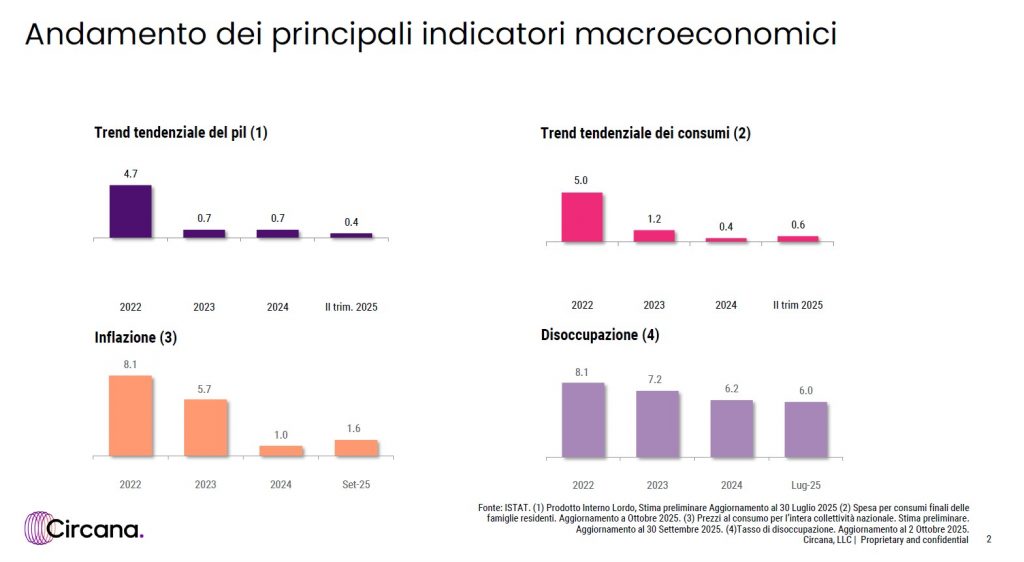
The Circana data tell a clear picture: GDP and consumption grow by just 0,4% in the second quarter of 2025, inflation has returned to 1,6%, and the unemployment rate has fallen to 6%. But behind these apparently positive numbers lies a crucial phenomenon: the end of nominal growth and the beginning of real competition on volumes.
Value sales (AT September) grow by 3,3%, but this time driven by a +1,9% in volumes and by an inflation that is now physiological on the price lists (+1,4%). This is proof that the price lever has lost strength, and that the difference will be made by the retailers' ability to win back consumers with assortments, formats and authentic convenience.

As the macro indicators settle, the channel map redraws itself.
- hyper and super volumes are growing (+2,2%) also thanks to more selective promotional policies and the expansion of proximity formats. Promotional pressure, after reaching 24,4% in 2024, is reduced to 23,8%, a sign that retail has understood the need to defend margins and average value of the receipt.
I discount, the undisputed leaders of the last three years, continue to grow but are slowing (+1,3% in volume versus +3,3% in 2024). This is an important signal: the "inflationary migration" effect toward the low-price channel is easing, and internal competition is shifting to efficiency and productivity per square meter.
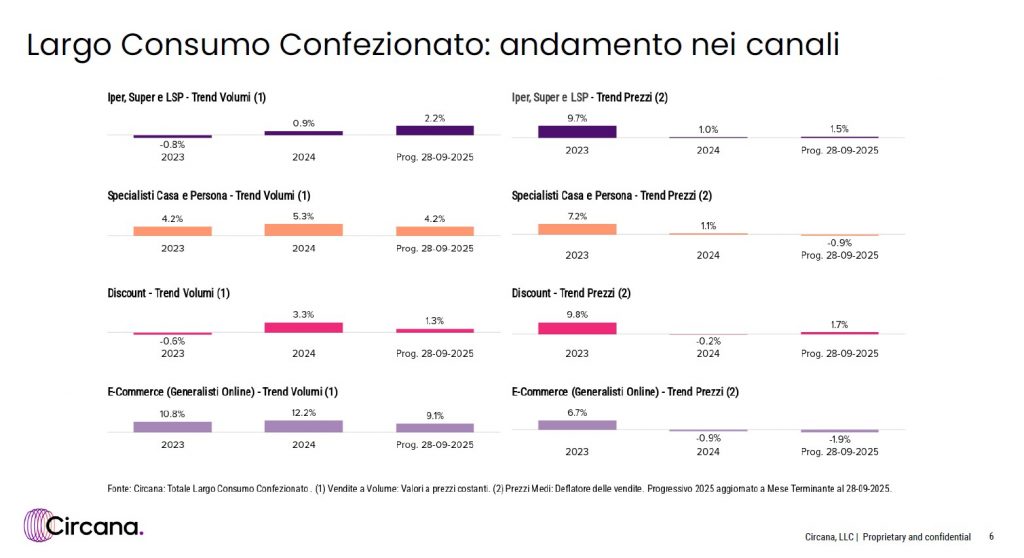
- home and personal specialists remain solid (+4,2% volumes), supported by a recovery in personal care and the entry of new affordable brands, while thee-commerce confirms its structural role in mass consumption, growing by +9,1% in volumes but with a price deflation of -1,9%It's a sign that the digital channel has overcome the pandemic and is seeking its own economic balance, based on loyalty and subscription models, no longer just on immediate convenience.
Overall, packaged consumer goods are moving on more rational tracks: prices under control, margins to defend and modest but sustainable growth. However, consumer confidence remains fragile.
Real income, although slightly improving, is not enough to generate an expansionary cycle. Spending is concentrated on essential segments and products with the best quality/price ratio, penalizing premium brands and pushing retailers to increase their mid-range private label, now considered the most effective strategic lever for building loyalty and protecting profitability.
This dynamic is consistent with what can also be observed in the foreign markets with which the Italian system is confronted: the Spain, which has already experienced a similar inflationary rebound, is now showing recovering consumption and strong growth in private label; while in Latin america (Colombia and Peru in particular) – as can be seen from our articles dedicated to that continent – the discount model is reproducing the same evolutionary pattern, with a rapid concentration of the market and a substitution effect on traditional commerce.
In Italy, the same process is proceeding more slowly, but structurally similar.