Editorial by Andrea Meneghini
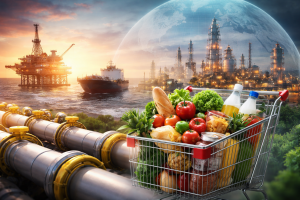
In just a few days, the global energy market has returned to the center of attention. The war involving Iran has immediately pushed gasoline prices higher and renewed tensions in oil and gas markets. As expected, geopolitical uncertainty has revived a question that many believed had been settled after the 2022 energy crisis: how vulnerable is the European economy to a new energy shock?
For those observing the food supply chain—from industry to retail—the answer is straightforward: much more than commonly believed.
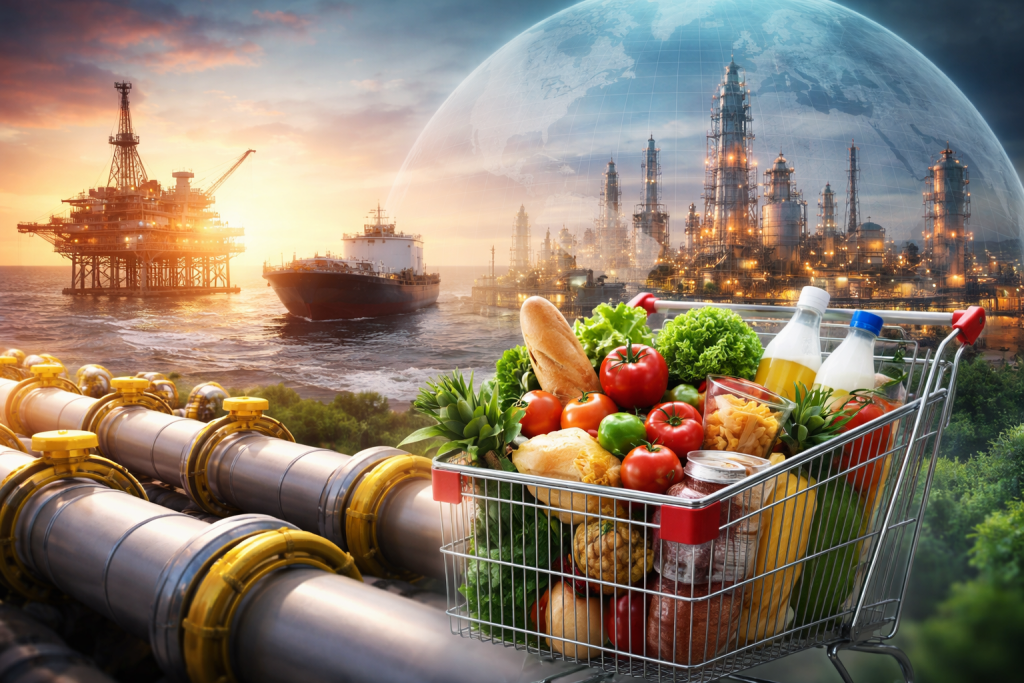
Energy is a structural component of food production. Industrial ovens, evaporation systems, sterilization processes, refrigeration, cold chains and temperature-controlled logistics make the food industry one of the most energy-intensive industrial sectors. In many segments, energy accounts for 8% to 20% of industrial costs, and in highly energy-dependent sectors—such as frozen foods, dairy or canned products—it can be even higher.
This means that any significant change in energy prices tends to propagate throughout the entire supply chain: from production to industry, from logistics to distribution, and ultimately to supermarket shelves.
With the (hopefully temporary) disruption of the Strait of Hormuz, the global energy market has entered a fragile equilibrium. This is not yet a crisis comparable to 2022, but the system depends on a handful of extremely sensitive logistical and geopolitical nodes: Hormuz itself, the Red Sea, the Suez Canal and the Black Sea. A large share of the world’s energy flows through these routes, and even limited tensions in any of these areas can produce immediate effects on global markets.
To understand what may happen in the coming weeks—particularly after Easter—it is useful to consider three possible scenarios.
The first scenario is one of significant energy tension. Imagine the Strait of Hormuz remaining effectively closed, with Iran targeting oil tankers to the point of discouraging shipping companies and insurers. In such a situation, European gas prices could easily rise above €40 per megawatt hour, while oil could exceed $100 per barrel. This would signal that markets have fully priced in geopolitical risk or a reduction in global supply. The immediate consequence would be rising industrial costs. The food industry would face higher energy and logistics expenses which, within a few months, would inevitably translate into renewed inflation in food prices. It would not replicate the extreme conditions of 2022, but food inflation could return to the 4–6% range within months.
The second scenario—currently the most likely—is a stable but tense energy market. Gas between €30 and €40 and oil between $80 and $100 would indicate a functioning system that nonetheless incorporates geopolitical risk premiums. In this case, the food industry would likely manage the situation through efficiency improvements, logistics optimization and margin compression. Consumer prices would still rise, but gradually, within a moderate food inflation range of 2–3%. This scenario allows the system to adapt without major shocks, while keeping retailers highly focused on cost management.
The third scenario, less probable today, would be a return to favorable energy conditions. Gas below €30 and oil below $80 would significantly reduce industrial and logistics costs, allowing companies to recover margins and retailers to return to more aggressive promotional strategies. In such a context, food inflation would stabilize or even disappear. However, this scenario requires geopolitical stability and a balanced global energy market—conditions that currently appear difficult to guarantee.
For international food buyers, particularly in Latin America, there is another important dimension to consider: the difference between European and North American suppliers.
European food production is structurally more exposed to energy volatility. Europe imports a large share of its energy and its industrial system is highly sensitive to fluctuations in gas prices. When energy costs rise sharply, European manufacturers often face significant pressure on production costs, logistics and margins.
North American suppliers—especially those in the United States—operate in a very different energy environment. The shale oil and shale gas revolution has transformed the U.S. into one of the world’s largest energy producers. This has created a more stable and often lower-cost energy base for industrial production. As a result, American food producers are generally less exposed to sudden energy price shocks.
For Latin American retailers and importers, this difference can become strategically important. In periods of energy volatility, European suppliers may face higher production costs and potential price adjustments, while North American suppliers may benefit from a more stable energy structure.
This does not mean European food exporters lose competitiveness. On the contrary, Europe remains a global leader in quality, innovation and premium food categories. But it does mean that energy volatility can temporarily alter price dynamics and supply strategies in international markets.
For this reason, large retail operators across the world are watching energy markets very closely. Whenever energy costs rise significantly, three immediate effects tend to follow: stronger negotiation pressure on suppliers, expansion of private label programs, and greater consumer sensitivity to price.
Energy, in other words, is no longer just an industrial input. It has become a strategic variable shaping the structure of the food market itself.
And in the coming months, more than the absolute level of prices, it will be the stability of the global energy system that determines the balance between industry, retail and consumers.