

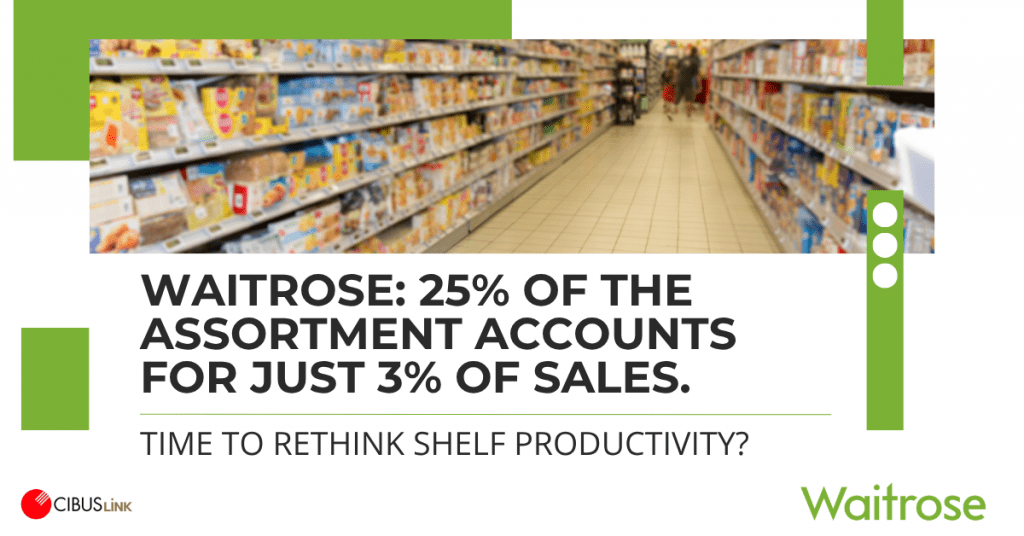
Waitrose recently hosted an online briefing with its suppliers as part of its “Home of Food Lovers” strategy, outlining its intention to optimize its product assortment by focusing on key growth areas, including its private label offering.
The briefing was led by Chief Commercial Officer Charlotte Di Cello, who revealed that approximately 25% of Waitrose’s assortment generates only 3% of total sales, identifying this as a critical area requiring strategic action.
While no final decisions have yet been made regarding shelf resets or the delisting of low-performing products, Waitrose emphasized that suppliers will be actively involved during the early stages of the review process.
The retailer also reassured suppliers that it remains committed to maintaining a vibrant and diverse portfolio, balancing established brands, emerging businesses and innovation, while allocating additional shelf space to best-selling products in order to improve on-shelf availability.
This represents a clear indication that Waitrose is preparing for a significant assortment rationalization. Although the timing and execution have not yet been defined, suppliers with low-rotation products should carefully evaluate the performance of their listings.
In practical terms, the message is straightforward: around one-quarter of the products currently on shelf generate very limited sales. These low-performing SKUs consume valuable shelf space, increase supply chain complexity and operational costs, and reduce overall category efficiency. By eliminating or consolidating these products, retailers can simplify the shopping experience while preserving the vast majority of their sales.
This is a classic application of the Pareto Principle in retail.
For Waitrose, however, the strategy goes beyond operational efficiency. Its positioning as the “Home of Food Lovers” is not about offering the largest assortment, but about curating the most relevant one. The objective is to create clearer assortments, eliminate unnecessary duplication, accelerate innovation, increase visibility for truly differentiated products and improve availability of high-performing lines.
What This Means for Suppliers
For suppliers, the implications are significant: securing a listing is no longer enough. Every SKU must demonstrate its ability to generate incremental sales, create additional value for the category and contribute to overall assortment productivity.
Products that merely duplicate existing offerings will face increasing pressure, while retailers will demand stronger evidence of commercial performance through measurable indicators such as sales velocity, margin contribution, shopper differentiation and incremental category growth.
The competitive advantage is no longer built on expanding the number of products on shelf, but on maximizing the productivity and strategic value of every single SKU.